Core Clans
Systema Delenda EstThe Core Clans are the hereditary ruling bloc of the System’s inner worlds, known variously as the Elder Clans and the Great Clans. Their authority rests on territorial scale, privileged proximity to the True Core, control of the principal portal thoroughfares, and access to divine mechanisms capable of condemning or purifying entire worlds. They are therefore not merely powerful families but a governing order whose management of essence, worlds, and independent gods determines the political shape of the System. Cato’s war transforms them from a distant background institution into the central authority opposing his expansion, while also revealing how much of their stability depends on isolation, inherited privilege, and the System’s willingness to enforce their decisions.
Structure and Territorial Power
The Core Clans possess territories on a scale that makes ordinary inter-clan rivalry resemble administration across continents. Clan Eln alone controls hundreds of worlds, and the loss of half of the worlds taken by Cato removes two millennia of expansion in only a few days. The crisis is consequently interpreted not as a local failure but as a disruption of the balance between the Clans. When Marus brings evidence of Cato’s attacks before the elders, the response is immediate: potent divine users from Clan Eln and other clans appear beside the presiding Elder, demonstrating that the Core Clans can summon a cross-clan leadership circle when their collective position is threatened. The Clans’ geography is itself an instrument of rule. Cato’s mapping shows that they have staked out the main portal connections, leaving independent gods concentrated in small pockets and dead ends. This arrangement does not necessarily remove independent gods from their worlds, but it prevents them from forming an easily connected power bloc. The resulting political landscape resembles controlled circulation: the major clans occupy the routes through which armies, resources, and information can move, while unaffiliated deities are kept apart by distance and infrastructure. The arrangement is not fully successful, since the independent gods eventually begin coordinating, but its original purpose is clear.
Access to the True Core
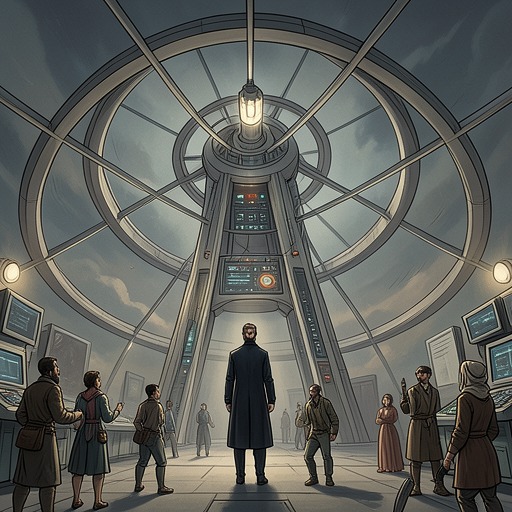
The hierarchy of the Core Clans is reinforced by graded access to the System’s heart. In the outer vestibule of the True Core, Elder World Deity Keppel Eln joins dozens of other divine figures, but combat Skills are forbidden there both by agreement and by the System’s own declaration. Only a small subset of beings with divine affinity may approach closely enough to commune directly with the System. The True Core’s central construct joins detached System Spaces, the most essence-rich world in existence, and the surrounding Core Worlds into one immense divine center. The nearer a deity’s world is brought to it, the more essence becomes available and the more authority that deity gains over the System’s inner workings. Keppel’s position illustrates the practical value of this access. Through a System-mediated interface, he inspects the results of a Crusade against the Lundt Clan and reviews the possibility of purifying worlds. He recognizes that planetary purification is an extraordinary measure, but also sees its material advantage: the recovered essence can be redirected into other Clan Eln worlds, increasing the Clan’s future generation while allowing Keppel to draw a personal share into his Estate and body. The arrangement turns catastrophe into a fiscal opportunity. Worlds are treated not only as inhabited territories but as assets whose destruction can produce a windfall for the clans positioned to claim it. The same structure produces a sharp distinction between the Core Clans and outsiders. The Ahruskians, although initially regarded as an external threat, are advancing too rapidly and in too great a number to fit the established pattern of inter-Clan proxy competition. Keppel considers them more dangerous than Cato in the long term because they promise internal discord. Yet the divine mandates of the System prevent the Core Clans from simply eliminating them, especially because independent World Deities support them. The Clans thus possess immense power without complete freedom: their authority is protected by the System, but it is also bounded by the same higher rules.
Response to Cato
Cato’s rise is especially threatening because it defeats the assumptions on which the Core Clans’ order depends. Their first instinct is to classify his forces by rank. One elder argues that Cato’s creatures are all merely Copper and proposes imposing minimum portal thresholds to cripple him. The calculation fails because Cato’s strength does not depend on moving one concentrated army through the portals. He uses industrial growth distributed across hundreds of worlds: factories, mines, refineries, atmospheric extraction, frozen-volatiles processing, solar-panel production, weapons, and Warframe manufacturing. His forces are local to each world, while his industrial capacity expands everywhere at once. The Core Clans are confronted by a distributed system that their portal restrictions and rank assumptions cannot easily measure. The Clans respond through collective emergency measures. They expand the Crusade and authorize divine gifts that allow Azoth-rank and higher individuals to fight Cato’s creations beyond a world’s immediate environment. A Nexus crystal mounted in a chain can project the System around those who venture into the darkness between worlds. At the same time, the leadership identifies independent worlds as especially dangerous because their rulers cannot be trusted to act according to Core policy. These worlds are to be approached individually and in stages, so that they can be brought under Clan control without provoking a unified response. This policy gives the crisis a second target. Cato is the stated invader, but the Core Clans use his presence to tighten their authority over gods who are not part of the Nine Great Clans. The proposed solution is not simply military defense; it is political consolidation backed by the threat of planetary destruction. Marus understands the contradiction. Purging Cato-controlled territory may make the System safer and weaken rival clans, but every world removed also means fewer worlds left to administer. The emergency therefore rewards the Clans materially even as it damages the territorial order they claim to defend.
Conflict with Independent Gods
The Core Clans’ treatment of independent gods creates the coalition that threatens to escape their control. Mii-Es argues that the Elder Clans’ unilateral decision to destroy worlds is more dangerous than Cato himself. In her view, Cato can be confronted by individual deities, as Initik has demonstrated, whereas the beings holding the deepest levers of power cannot be contested by ordinary means. Initik consequently presents a meeting of clanless gods as a defensive necessity, claiming that those beholden to neither the Core Clans nor their political machinery are unsafe from both Cato and opportunistic Clan intervention. Cato’s intelligence confirms the structural basis of that fear. The independent gods are not distributed randomly: the Clans have isolated them geographically, assigning them small pockets and dead ends while retaining the main portal routes. Cato would prefer to assist System-Gods who care about their populations, but he cannot yet negotiate openly with their alliance. Instead, he reinforces vulnerable worlds, sends additional material through Jager frames, and positions orbital forces near worlds likely to suffer from a Core purge or become willing to turn away from the System. The condemnation of Gyvestral makes the danger immediate. The world is the last place where Raine and Leese were seen by Muar and the place from which Yaniss evacuated them. Its World Deity has already reached an agreement with the Core Worlds, and the Clans intend to avoid the resentment caused by an earlier purge by securing cooperation from a scion. The episode shows how the Core Clans combine formal condemnation with elite bargaining: destruction is presented as a System necessity, but the terms are negotiated according to lineage and political status.
Political Meaning and Legacy
The Core Clans embody a system of governance in which inherited administration, restricted access, and resource extraction reinforce one another. Their power is not simply personal strength. It is the ability to define which worlds are valuable, which gods are trustworthy, which crises justify extraordinary measures, and where the essence recovered from destruction will go. Their privileged position is sustained by the very infrastructure they control, particularly the portal network and the graded access to the True Core. Yet the Clans’ response to Cato reveals a dangerous feedback loop. Cato’s distributed industrial growth accelerates faster than their inherited categories can interpret it. Their answer is to impose tighter restrictions, condemn more worlds, and absorb independent powers; those actions in turn make more gods fear the Core than the invader. Misse later states the Core position openly, describing Cato as having compromised essentially the entire frontier and proposing that the frontier be severed. She insists that this is a protective measure rather than a seizure of territory, but the distinction is politically unstable: severance protects the Core by abandoning the outer worlds and strips the Clans of access to the population and essence beyond the boundary. The resulting confrontation reaches the level of the System’s physics. When Misse and Muar restrict the System’s influence, the System withdraws to the True Core, essence drain stops, and the Font provides instead. Around the War Worlds, physics resumes, gravity takes hold, and a hundred suns are suddenly almost touching. The spectacle exposes the scale of power the Core Clans have been manipulating, but it also shows that their authority is not equivalent to control. Their attempt to prune the crisis triggers a rapid loss of essence at the Core itself. The Core Clans remain the principal institutional force in the System, yet their effort to preserve that order becomes one of the mechanisms driving its final destabilization.